
The Ultimate Guide to DIY E-Bike Battery Care
Your E-Bike Battery Is More Valuable Than You Think
DIY e-bike battery care is the single most impactful thing you can do to protect your investment and keep your rides smooth year-round.
Here’s a quick summary of the core practices:
- Charge between 20–80% for daily use to reduce voltage stress on cells
- Avoid extreme temperatures — store and charge between 50–77°F (10–25°C)
- Store at 40–60% charge if leaving the bike unused for weeks or months
- Always use your original charger — mismatched chargers can damage cells or cause fires
- Let the battery cool 30–60 minutes after a ride before plugging in
- Check the charge level monthly during storage and top up if it drops below 30%
- Keep contacts clean and dry — corrosion is one of the most common preventable issues
Your e-bike battery is the most expensive single component on your bike. Replacements typically run $400 to $1,000, and that’s assuming you can find one that fits your model.
The good news? Most battery damage is preventable. Charging habits alone account for 40–60% of long-term battery health, according to real-world testing data. That means the way you plug in after a ride matters more than almost anything else.
A well-maintained lithium-ion e-bike battery can last 5–7 years or 700–1,000 charge cycles. Neglect it — leave it drained in a cold garage all winter, or charge it overnight repeatedly — and you might see noticeable capacity loss in as little as 18 months.
The goal of this guide is simple: give you practical, science-backed habits you can build into your routine without needing a mechanic or special tools.
Understanding E-Bike Battery Metrics and Anatomy
To master DIY e-bike battery care, we first need to understand what’s happening inside that sleek plastic or metal casing. Modern e-bikes almost exclusively use Lithium-ion technology, specifically chemistries like Lithium Nickel Cobalt Manganese (Li-ncm). These are chosen for their high energy density, meaning they pack a lot of “go” into a relatively light package.
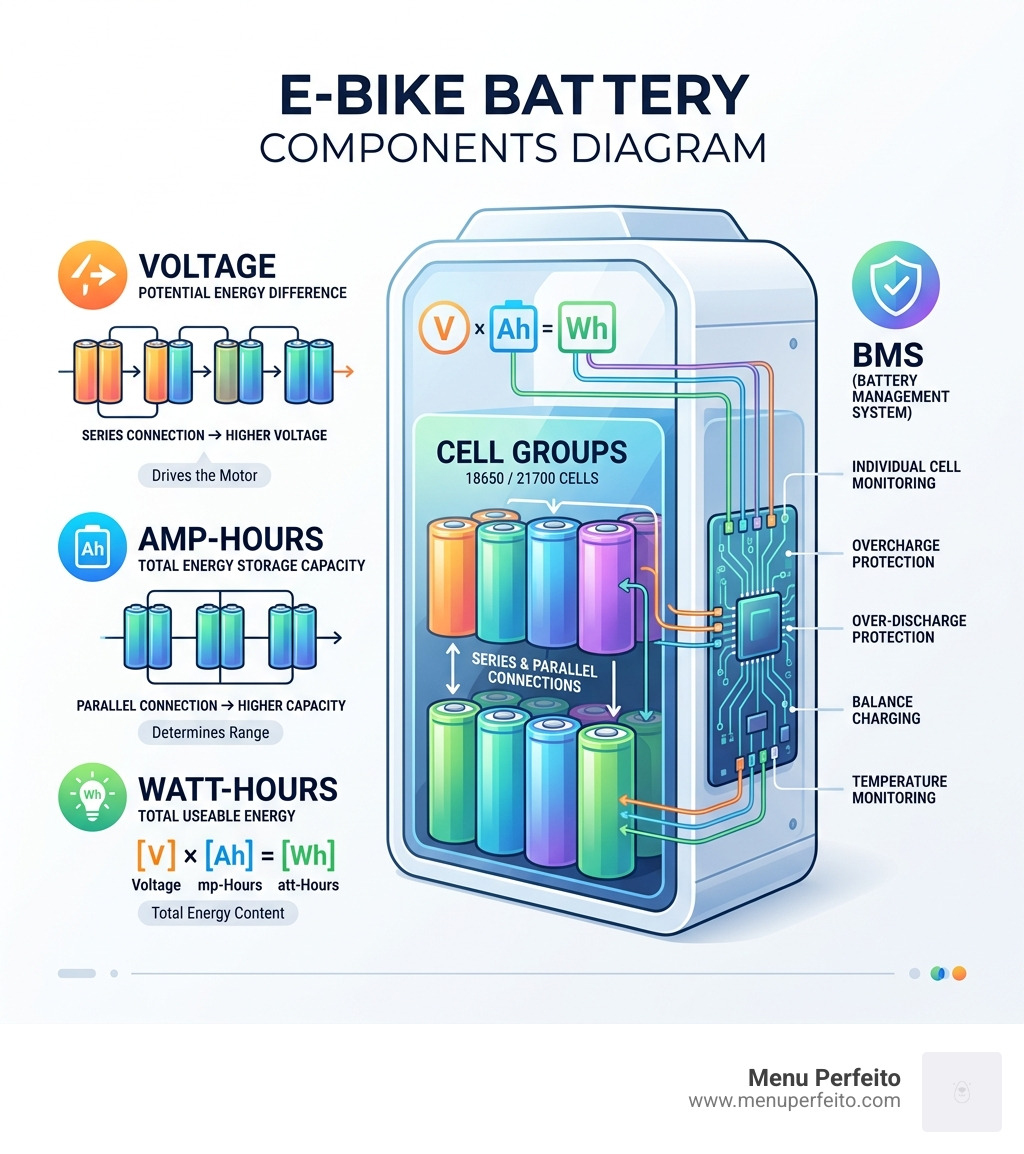
Think of your battery as a collection of small energy canisters called cells. These cells are wired together in cell groups. To understand how they work, we look at three main metrics:
- Voltage (V): Think of this as electrical pressure. Most e-bikes operate at 36V, 48V, or 52V. This dictates the “punch” or power the motor can deliver.
- Amp-hours (Ah): This measures the capacity or “fuel tank” size. A 15Ah battery can theoretically provide 15 amps of current for one hour.
- Watt-hours (Wh): This is the ultimate metric for range. You calculate it by multiplying Volts by Amp-hours (V * Ah = Wh). A 48V 15Ah battery gives you 720Wh of total energy.
The “brain” of the operation is the Battery Management System (BMS). The BMS is a circuit board that monitors every single cell group. It prevents the battery from getting too hot, keeps the voltage from dropping too low (which could kill the battery permanently), and ensures the cells stay balanced. Scientific research on lithium-ion battery degradation shows that the primary failure mechanism is the growth of a Solid Electrolyte Interphase (SEI) layer on the anode. While some of this is natural aging, our DIY habits can either slow this down or speed it up.
Master DIY E-Bike Battery Care Through Smart Charging
Charging isn’t just about plugging a cord into a wall; it’s the most critical part of DIY e-bike battery care. If you get the charging right, you’ve won 60% of the battle.
First and foremost, always use your OEM (Original Equipment Manufacturer) charger. While “universal” chargers are tempting, they often lack the precise voltage regulation your BMS expects. A charger that drifts even slightly too high can reduce cycle life by 30-40%.
One of our favorite tips at Menu Perfeito is the cool-down period. After a long, hilly ride, your battery cells are physically warm. If you plug them into a charger immediately, you’re adding “charging heat” on top of “riding heat,” which accelerates chemical aging. Always wait 30–60 minutes after a ride before charging.

DIY E-Bike Battery Care: The 80/20 Rule
If you want your battery to last until April 2031, stop charging it to 100% every single day. Lithium-ion batteries are like rubber bands; they don’t like being stretched to their absolute limit.
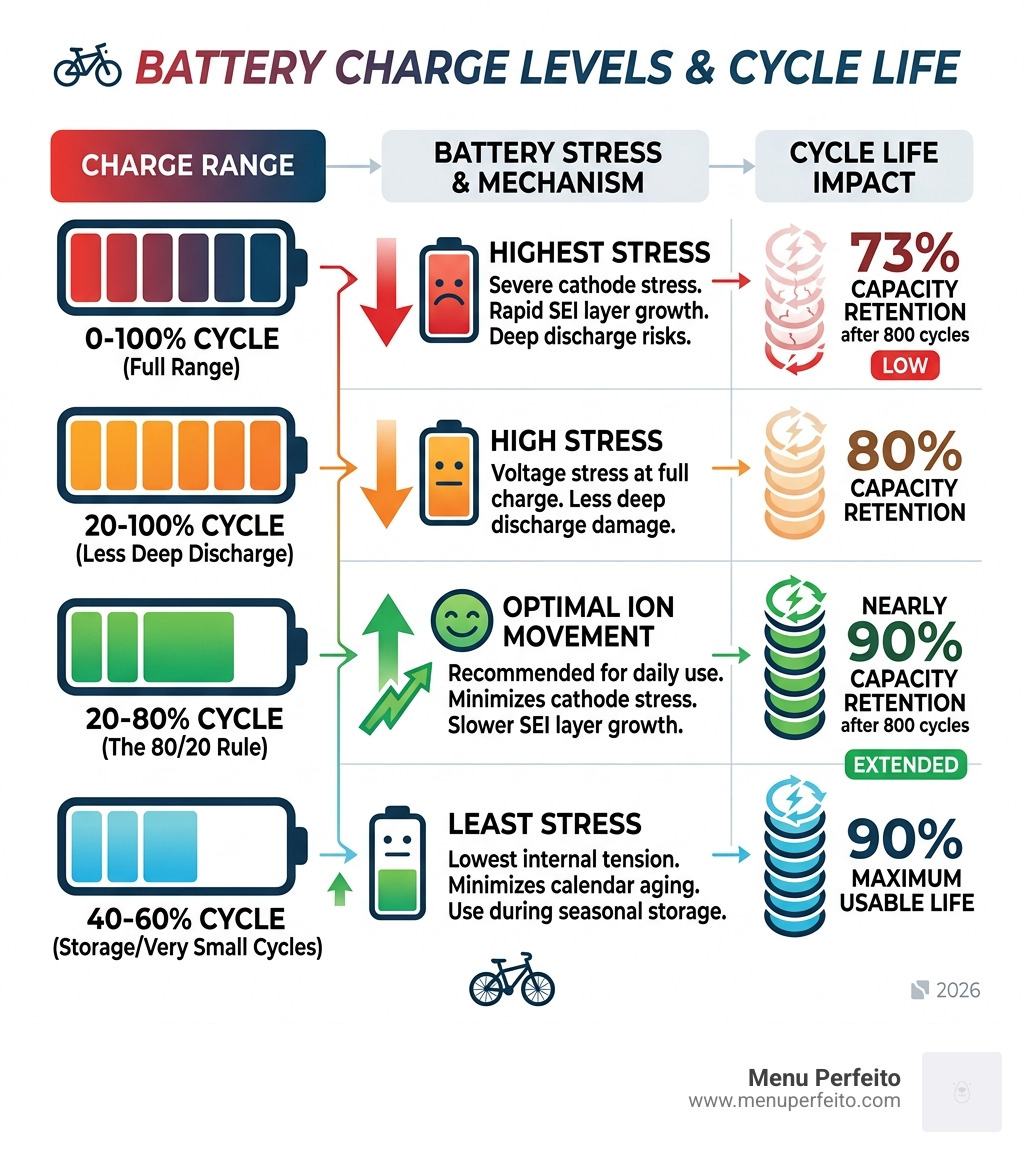
The 80/20 rule suggests keeping your battery between 20% and 80% charge for daily use. Charging to 100% creates voltage stress on the cathode and accelerates SEI layer growth. Research shows that batteries cycled between 20-80% can retain nearly 90% of their capacity after 800 cycles, whereas those cycled 0-100% might drop to 73% in the same timeframe.
- When to hit 100%: Only when you know you have a massive ride planned the next morning.
- When to plug in: Ideally when you hit the 20-30% mark. Letting it drop to “true zero” can cause the BMS to “lock” the battery for safety, often requiring a professional reset or replacement.
Advanced DIY E-Bike Battery Care: Balancing Cells
While the 80/20 rule is great for longevity, doing it forever can lead to cell drift. This is when some cell groups have slightly more energy than others, leading to voltage sag (where the bike feels sluggish under load) or inconsistent range readings.
To fix this, we recommend a “balancing charge” once every month or every 20-30 cycles.
- Charge the battery to 100%.
- Leave it on the charger for an extra 1–2 hours after the light turns green.
- This allows the BMS to engage passive balancing, slowly bleeding off excess energy from “high” cells so the “low” cells can catch up.
Seasonal Storage and Temperature Management
Temperatures are the silent killers of e-bike batteries. As we move through April 2026, many riders are pulling bikes out of winter storage or prepping for summer heat.
The Golden Rule: If you are uncomfortable, your battery is uncomfortable.
- Heat Degradation: Storing or charging a battery above 90°F (32°C) can cause it to degrade twice as fast. Never leave your battery in a hot car or in direct sunlight. High heat increases the risk of thermal runaway, a dangerous state where the battery generates more heat than it can dissipate.
- The Winter Chill: Cold weather increases internal resistance. You’ll notice your winter range might drop by 20–50%. This is normal and usually temporary. However, never charge a frozen battery. Charging below 32°F (0°C) causes lithium plating, where metallic lithium builds up on the anode. This is permanent, irreversible damage that can eventually cause a fire.
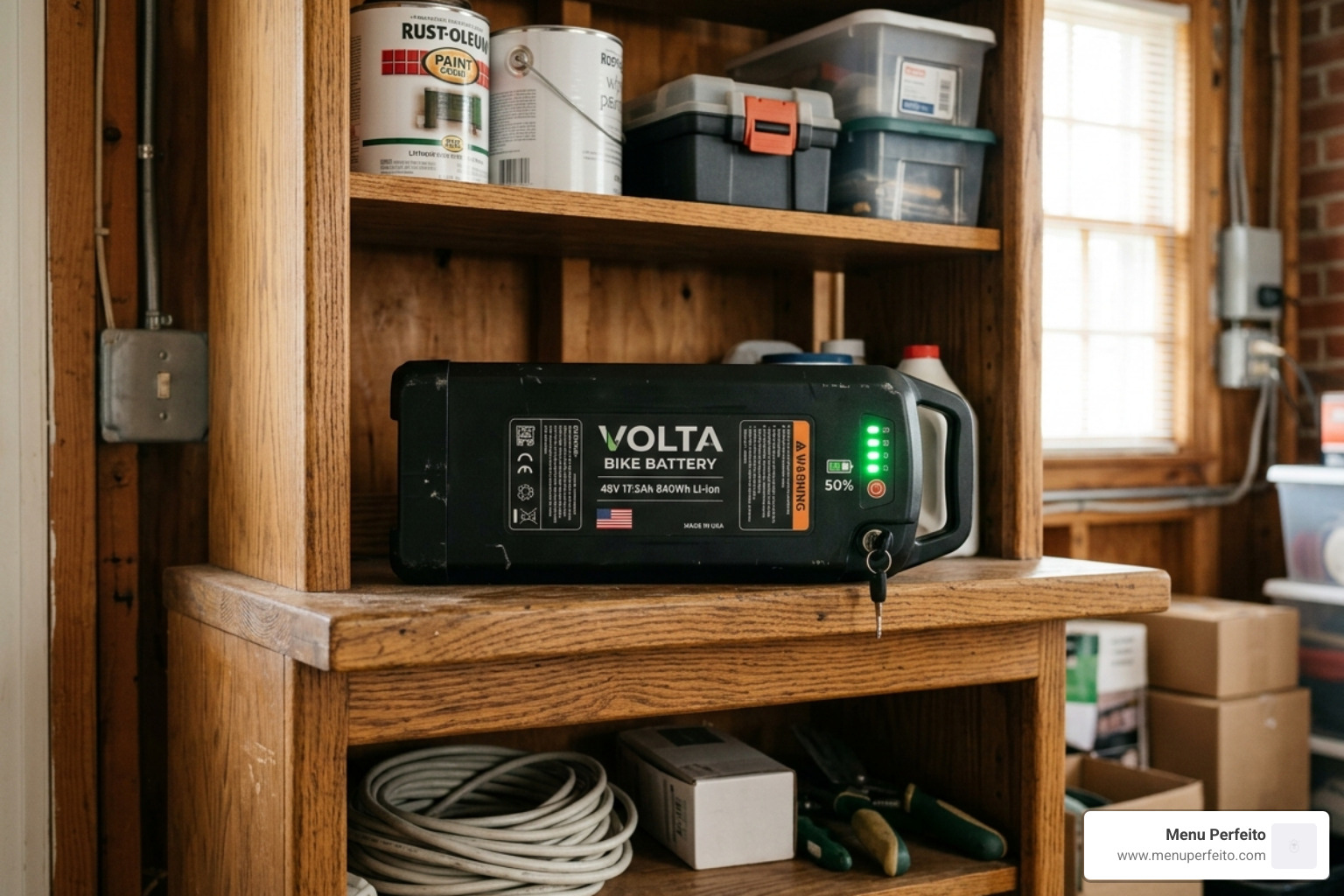
For long-term storage (more than two weeks), remove the battery from the bike and bring it indoors. Store it at room temperature (around 68°F or 20°C). The State of Charge (SoC) should be between 40-60%. Storing a battery at 100% for months causes calendar aging, while storing it at 0% risks a deep discharge that the BMS cannot recover from.
Essential Safety and Physical Maintenance Protocols
Safety is paramount when dealing with high-energy lithium packs. At Menu Perfeito, we always look for the UL 2849 certification on bikes, which ensures the entire electrical system has been tested for fire safety.
But safety also involves physical DIY e-bike battery care.
- Clean the Contacts: Every month, inspect the metal pins where the battery connects to the bike. Use a clean cloth and 90%+ isopropyl alcohol to remove dirt. If you see signs of oxidation, a tiny amount of dielectric grease can help prevent corrosion and ensure a solid connection.
- Check for Damage: If you drop your battery or have a crash, inspect the casing for cracks or bulging. Mechanical shock can damage the internal structure of the cells. If the case is compromised, do not charge it indoors.
- Vibration Management: Ensure your battery is seated tightly in its mount. Constant rattling can wear down the connectors and stress the internal wiring.
Most high-quality batteries have an IP rating (like IPX4 or IPX5), meaning they are water-resistant against splashes. However, they are not waterproof. Never use a pressure washer on your bike, as it can force water past the seals and into the electronics.
Troubleshooting and Frequently Asked Questions
How do I know when to replace my battery?
Batteries don’t usually die overnight; they “fade.” You’ll know it’s time to shop for a replacement when:
- You experience a 20-30% loss in range compared to when the bike was new.
- The bike cuts out or loses power during steep climbs (voltage sag).
- The battery feels unusually hot during a normal charge.
- The battery has surpassed the 3-5 year mark or 1,000 charge cycles.
Is it safe to use a third-party charger for DIY e-bike battery care?
Generally, we say no. If you must buy a replacement, it must match the original charger’s voltage, amperage, and connector polarity exactly. Using a 54.6V charger on a 42V battery is a recipe for a fire. Always look for safety certifications like UL or CE.
How can I protect my battery from water damage?
If you get caught in a downpour, remove the battery as soon as you get home. Dry the exterior with a towel and use compressed air or a hair dryer (on the cool setting only!) to dry the ports. If the battery was actually submerged, do not turn the bike on. Seek professional advice, as water inside the pack can cause a delayed short circuit.
Conclusion
Mastering DIY e-bike battery care doesn’t require a degree in electrical engineering. By simply being mindful of how you charge, where you store your pack, and keeping those connectors clean, you can easily double the lifespan of your battery.
At Menu Perfeito, we believe in DIY empowerment. Consistency is more important than perfection. If you forget and charge to 100% occasionally, don’t sweat it—just try to stick to the 80/20 rule most of the time. These small habits ensure that in April 2026 and beyond, your e-bike remains a reliable, high-performance machine.
For more expert tips on keeping your ride in peak condition, explore our other e-bike maintenance services. Ride safe, and keep those cells happy!
