
The Ultimate Guide to E-bike Chainring Bolt Maintenance and Torque
Why E-bike Chainring Bolt Tightening Matters More Than You Think
E-bike chainring bolt tightening is one of the most important — and most overlooked — maintenance tasks for any e-bike owner.
Here’s the quick version:
- Check your bolts every 500 miles or after rough rides
- Steel bolts: tighten to 8-14 Nm; Aluminum bolts: tighten to 5-10 Nm
- Always tighten in a star (criss-cross) pattern for even pressure
- Use a torque wrench — never guess with e-bike components
- Consult your motor system’s manual — specs vary by brand (e.g., Shimano STEPS E-8000 calls for 12 Nm)
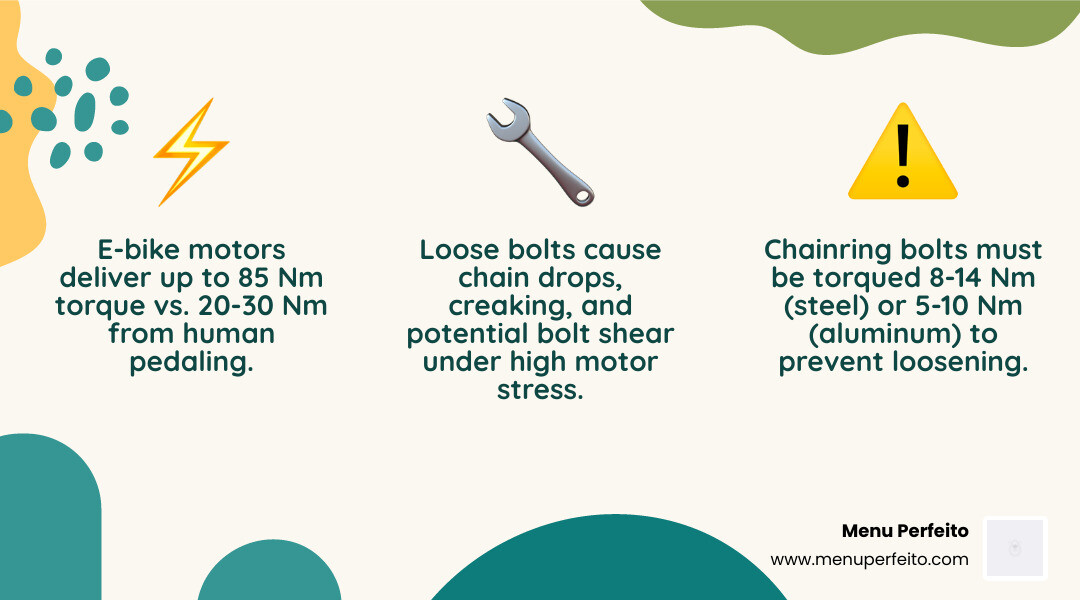
E-bikes are not regular bicycles. A mid-drive motor can deliver far more torque through the drivetrain than human legs alone. That extra force puts serious stress on every bolt, chainring, and crank interface on your bike.
When chainring bolts are even slightly loose, the results can range from annoying — creaking, poor shifting, chain drops — to genuinely dangerous, like a chainring detaching mid-ride.
And overtightening isn’t safe either. Strip the threads on an aluminum chainring bolt and you’re looking at a costly repair, or a full chainring replacement.
Getting the torque just right is the difference between a drivetrain that runs smoothly for thousands of miles and one that wears out fast or fails unexpectedly.
This guide walks you through everything: the right tools, the correct torque specs for major e-bike motor systems, a clear step-by-step process, and how to troubleshoot the most common problems.
Why Proper E-bike Chainring Bolt Tightening is Critical
We often think of our e-bikes as “set it and forget it” machines, but the high-torque output of modern mid-drive motors tells a different story. Unlike a traditional acoustic bike, where the only force comes from your legs, an e-bike motor (like a Bosch Gen4 or Shimano EP8) adds hundreds of watts of power directly to the chainring.
This mechanical “muscle” creates significant vibration and stress. If your e-bike chainring bolt tightening isn’t up to spec, those vibrations will eventually cause the bolts to back out. Once a bolt is loose, the chainring can flex or warp. This leads to a “shark-finning” wear pattern on the teeth, poor power transfer efficiency, and eventually, bolt shear—where the bolt literally snaps under pressure.
Furthermore, most modern e-bikes utilize 1x drivetrains with narrow-wide chainrings. These rings are designed to grip the chain tightly to prevent drops. However, if the bolts are loose, the alignment shifts, and that narrow-wide magic disappears, leading to frequent chain derailments. As noted in the SRAM Rival Chainring Bolt Tightening Guide: How to Get It Just Right – Road Bike Maintenance, ensuring proper tension is the only way to maintain the integrity of these high-performance components.
Proper tightening also prevents that dreaded “mystery creak.” If you hear a clicking sound every time you push down on the pedals, it’s rarely the motor—it’s usually a dry or slightly loose chainring bolt rubbing against the spider.
Essential Tools for E-bike Maintenance
To do this job right, we need more than just a rusty hex key from the kitchen drawer. E-bike components are precision-engineered, and the margin for error is slim. Here is what we recommend keeping in your DIY kit:
- Torque Wrench: This is non-negotiable. Because e-bike motors apply so much force, “tightening by feel” often leads to under-tightening (risking the ring falling off) or over-tightening (stripping the motor spider).
- 5mm Allen Key and 4mm Hex Bit: Most standard bolts use these sizes. Ensure they are high-quality bits that won’t round out the bolt heads.
- Chainring Nut Wrench: Many chainring bolts have a slotted nut on the backside. Without this tool to hold the nut steady, the bolt will just spin in circles.
- Motor-Specific Lockring Tools: If you have a Bosch or Shimano mid-drive, you may need a proprietary tool to remove the lockring before you can even see the bolts.
- Digital Calipers: Useful for measuring your chainline or checking bolt diameters.
- Cleaning Supplies: Isopropyl alcohol and clean rags are essential for degreasing the threads before re-assembly.
- Blue Threadlocker & Grease: A tiny drop of medium-strength threadlocker (like Loctite 243) prevents bolts from vibrating loose. For the interface between the bolt head and the chainring, a dab of waterproof grease prevents creaking.
As emphasized in the FC-R8000 Chainring Bolt Tightening Guide: How to Get It Just Right – Road Bike Maintenance, using the correct tools ensures you don’t damage the specialized finishes or materials found on premium e-bike groupsets.
Recommended Torque Specifications by Motor and Material
Torque is the measurement of rotational force, and on an e-bike, “close enough” isn’t good enough. The amount of force required depends heavily on whether your bolts are made of steel (heavy-duty) or aluminum (lightweight).
| Component / System | Material | Recommended Torque (Nm) | Recommended Torque (in-lb) |
|---|---|---|---|
| Standard Chainring Bolt | Steel | 8–14 Nm | 70–124 in-lb |
| Standard Chainring Bolt | Aluminum | 5–10 Nm | 44–88 in-lb |
| Shimano STEPS E-8000 (CRE80-B) | Steel | 12 Nm | 106 in-lb |
| Specialized Creo SL | Aluminum | 5 Nm | 44 in-lb |
| SRAM X-Range / Rival | Steel/Alloy | 10–12 Nm | 88–106 in-lb |
| Campagnolo Ekar 13s | Steel | 6 Nm | 53 in-lb |
| Bosch Gen4 Lockring | Aluminum | 20–25 Nm | 177–221 in-lb |
Standard Torque for E-bike Chainring Bolt Tightening
When we talk about e-bike chainring bolt tightening, we are actually aiming for something called “preload tension.” This is the process of stretching the bolt ever so slightly—like a very stiff rubber band—to create a clamping force that holds the parts together.
For steel bolts, the range is typically 8-14 Nm. Steel is forgiving and can handle higher loads. Aluminum bolts, often found on high-end or “SL” (Super Light) e-bikes, are much more delicate. They usually top out at 5-10 Nm. If you exceed this, the threads will strip instantly. Always check the Ekar 13s Chainring Bolt Tightening Guide: How to Get It Just Right – Road Bike Maintenance for specific adventure-bike specs, as gravel e-bikes often use lower torque to save weight.
Step-by-Step Guide to E-bike Chainring Bolt Tightening
Now, let’s get our hands dirty. Follow this process to ensure your chainring stays exactly where it belongs.
- Preparation: Secure your bike in a repair stand. If you don’t have one, ensure the bike is stable on flat ground.
- Cleaning: Use isopropyl alcohol and a rag to clean the bolt heads and the surrounding area. Dirt inside a hex head can cause your tool to slip and strip the bolt.
- Finger-Tighten First: Thread all bolts in by hand. This ensures you haven’t cross-threaded them. If a bolt feels “crunchy” or resists turning, stop and check the threads.
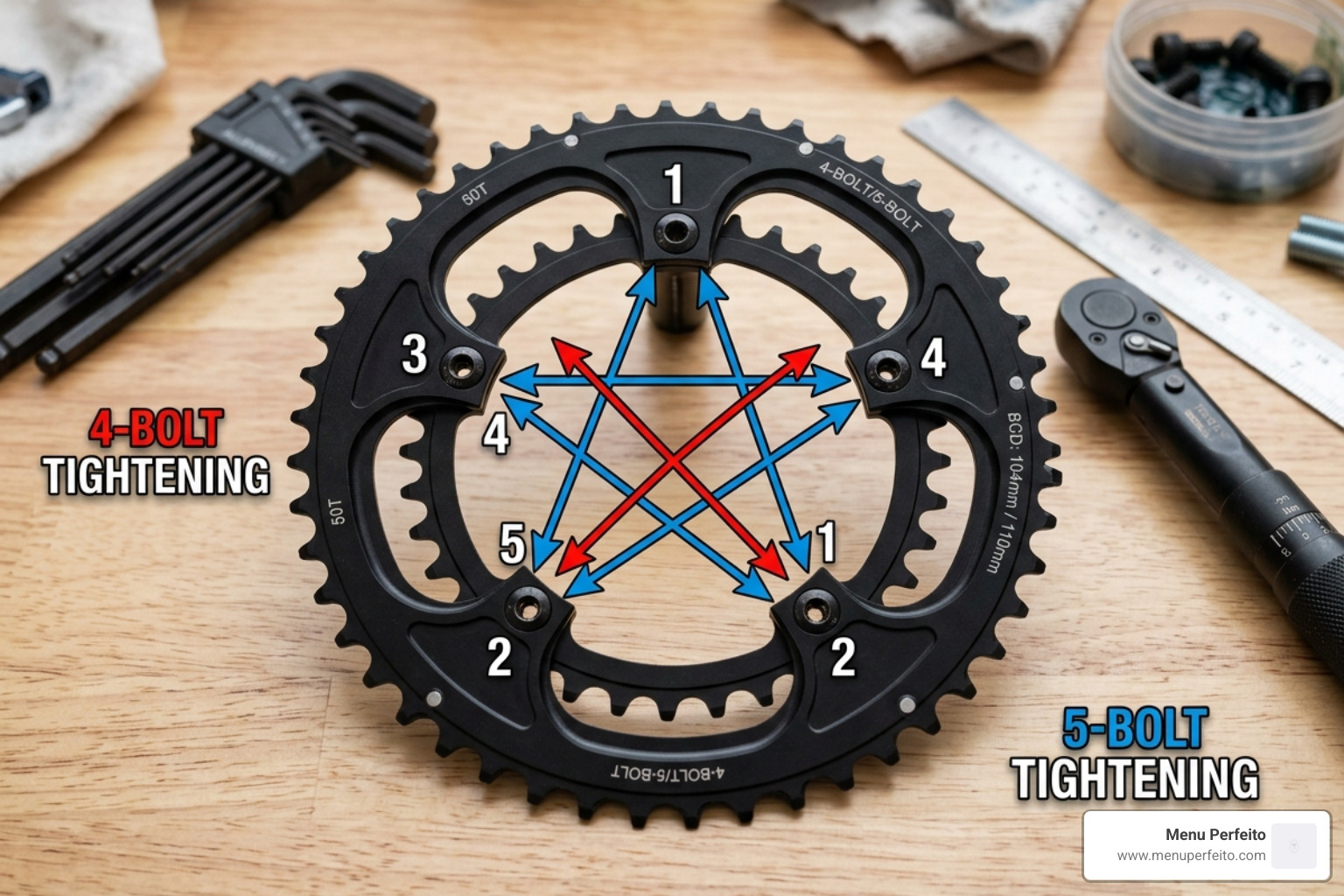
- The Star Pattern: Never tighten bolts in a circle (1, 2, 3, 4). This warps the chainring. Instead, use a star or criss-cross pattern. Tighten bolt #1, then move to the one directly across from it. This distributes pressure evenly.
- Snug Phase: Tighten all bolts until they are just “snug” (about 2-3 Nm) using your star pattern.
- Final Torque Check: Set your torque wrench to the manufacturer’s spec (e.g., 12 Nm for many SRAM systems). Click through the star pattern one last time. As noted in the SRAM X-Range Chainring Bolt Tightening Guide: How to Get It Just Right – Road Bike Maintenance, a final double-check of every bolt ensures none were missed during the sequence.
Preparing Your Drivetrain for E-bike Chainring Bolt Tightening
Before you start cranking on bolts, we need to talk safety and access. First, remove the e-bike battery or turn off the system. You don’t want the motor to engage while your fingers are near the chainring!
On many mid-drive systems, the chainring bolts are hidden behind the crank arm. You may need a crank puller to remove the arm first. Once the arm is off, inspect the chainring for wear. If the teeth look like waves or “shark fins,” it’s time for a replacement rather than just a tightening.
Cleaning is the most skipped step. We recommend removing the bolts entirely once a year to clean the threads. Apply a fresh dab of blue threadlocker or grease as specified by your manual. The Shimano FC-6700 Chainring Bolt Tightening Guide: How to Get It Just Right – Road Bike Maintenance highlights that clean mounting surfaces are the secret to a silent, creak-free drivetrain.
Troubleshooting and Common Maintenance Mistakes
Even with the best intentions, things can go wrong. Here are the most common pitfalls we see in our maintenance workshops:
- The “Hidden” Screw: On some e-bikes, like the Specialized Creo SL, the chainring might still feel loose even if the bolts are tight. This is often because the spider adapter (the piece that connects the motor to the ring) has its own hidden set screw or lockring that has backed out.
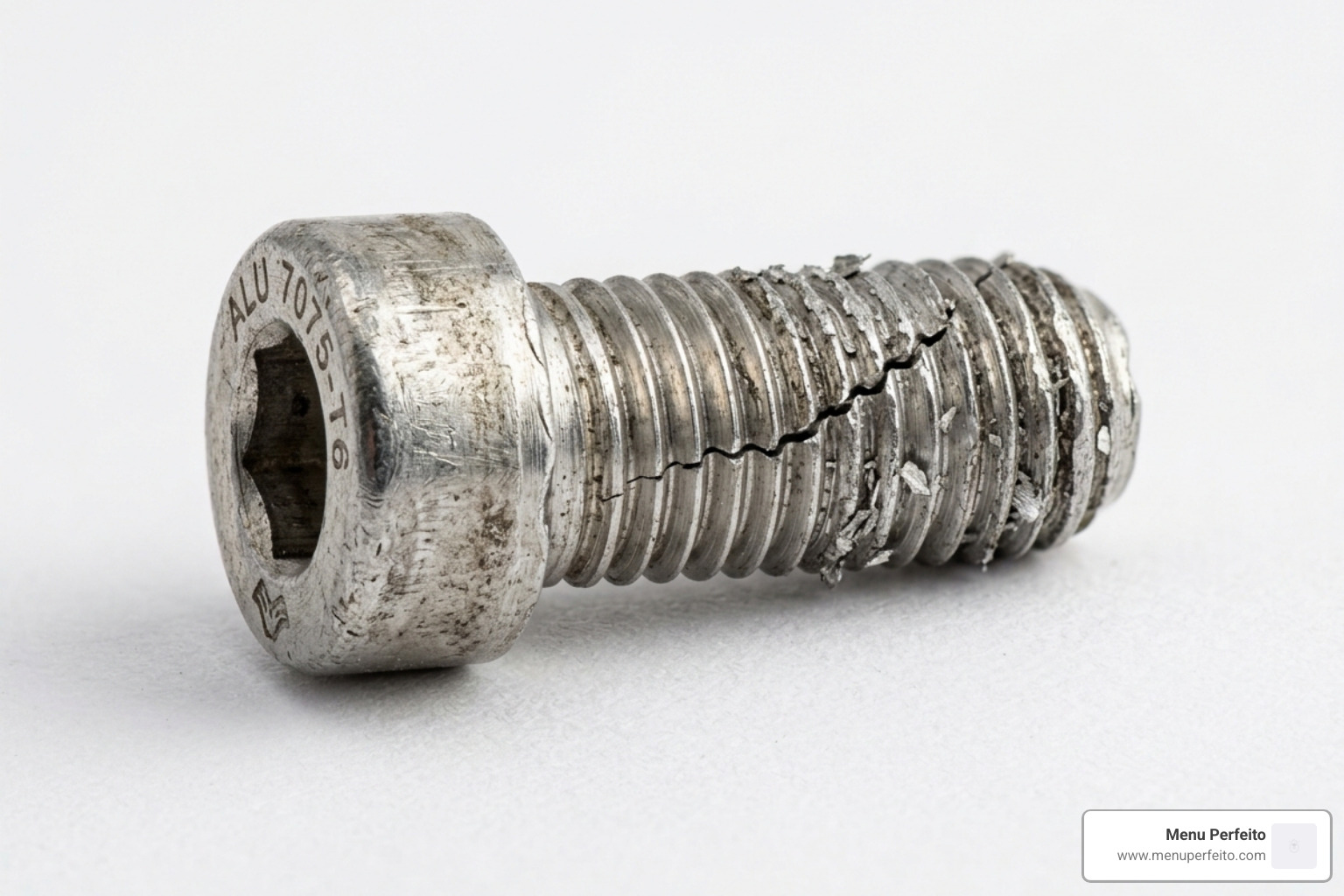
- Over-Tightening: This is the #1 cause of broken bolts. If you don’t use a torque wrench, it’s easy to over-torque aluminum bolts, causing them to snap mid-ride.
- Ignoring the Backside: Many riders forget to hold the rear nut with a chainring nut wrench. The bolt feels tight because it’s hard to turn, but it’s actually just spinning the nut in the housing.
- Vibration Loosening: E-bikes vibrate more than standard bikes due to the motor. If you don’t use threadlocker, you might find your bolts loose again in just 200 miles.
If you’ve tightened everything and still hear a creak, check the motor mounting bolts (the ones that hold the motor to the frame). These can also work loose and mimic the sound of a loose chainring. For more on these specific nuances, the SRAM X-Range Chainring Bolt Tightening Guide: How to Get It Just Right – Road Bike Maintenance offers excellent troubleshooting tips for modern 1x systems.
Frequently Asked Questions about E-bike Chainring Maintenance
How often should I check my e-bike chainring bolt tightening?
We recommend a quick check every 500 miles. However, if you ride in wet, muddy, or extremely bumpy conditions, check them every month. E-bike motors produce constant micro-vibrations that can back bolts out faster than you’d expect. A 10-second “wiggle test” before a ride can save you a long walk home.
Can I use standard bicycle chainring bolts on a mid-drive e-bike?
Technically, yes, if the BCD (Bolt Circle Diameter) and length match. However, we strongly suggest using steel bolts for mid-drive e-bikes. While aluminum bolts are fine for road bikes, the sheer torque of an e-bike motor can exceed the fatigue limit of lightweight alloy bolts over time. Steel provides the durability needed for high-wattage motor assistance.
Why is my e-bike chainring still shaking after tightening the bolts?
If the bolts are torqued to spec but the ring still wobbles, the issue is likely the spider adapter or the splined shaft. Mid-drive motors use a splined interface to transfer power. If the main lockring holding that spider to the motor is loose, the whole assembly will shake. You’ll need a motor-specific lockring tool to tighten this to a much higher torque (usually 25–40 Nm).
Conclusion
Mastering e-bike chainring bolt tightening is a fundamental skill for any rider who wants to get the most out of their machine. By using a torque wrench, following the star pattern, and keeping your drivetrain clean, you ensure that every watt of power from your motor—and your legs—goes directly into moving you forward.
At Menu Perfeito, we believe that e-bike ownership should be about the joy of the ride, not the stress of the repair. Whether you are tackling DIY repairs, focusing on battery care, or performing seasonal maintenance, taking the time to care for these small components pays off in long-term reliability.
Keep your bolts tight, your chain lubed, and your battery charged. For more tips on keeping your e-bike in peak condition all year round, Learn more about comprehensive e-bike care and maintenance. Safe riding!
